Grimpen Mire
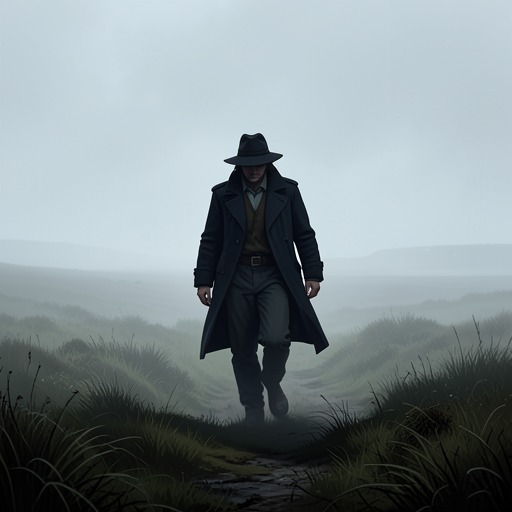
The Hound of the BaskervillesGrimpen Mire is the most dangerous feature of the desolate moor around Baskerville Hall: a landscape that looks traversable from a distance but resists safe passage and ultimately conceals Stapleton’s fate. Its green patches, shifting fog, and abandoned mine make the mire both a physical barrier and a place where visibility and certainty fail.
Setting and Terrain
On Sherlock Holmes’s large-scale map, Baskerville Hall occupies the center of the district, with the moor extending around it. Grimpen Mire lies within this sparse landscape of scattered dwellings and isolated landmarks. From afar, parts of the northern plain appear greener and more fertile than the surrounding ground, an inviting appearance that disguises the danger beneath it.
Stapleton knows the mire’s hazards well enough to warn Dr. Watson against venturing across it. Safe movement depends on remembering complex landmarks; without that knowledge, a seemingly open route offers little chance of return. The contrast between the plain’s promising surface and its perilous ground makes the mire a place where ordinary visual judgment cannot be trusted.
Routes and the Pursuit
The surrounding moor provides routes for pursuit but also makes distance and direction difficult to judge. In darkness, Sherlock Holmes, Dr. Watson, and Sir Henry Baskerville follow a small candle burning among rocks. Sheltered in a crevice and screened from view except toward Baskerville Hall, it serves as a signal across the open landscape. The episode shows how a tiny light can guide movement while revealing how exposed and uncertain the approach remains.
The mire’s dangers also shape what can be learned from the landscape. At dusk, Dr. Watson searches among the hills and finds an old stone hut that appears to have been used as a hiding place, but it is empty. Such shelters on the moor offer concealment without resolving who has passed through them; the wider landscape repeatedly gives investigators partial traces rather than a clear account.
Fog and the Hidden Refuge
Near Merripit House, Sherlock Holmes and his companions pause during their approach as a dense bank of fog drifts from the mire toward them. The moonlight makes the fog appear like a broad, pale field, but its slow advance is a practical threat: it can erase the visibility needed to move safely through the surrounding terrain. The fog turns the final approach into a waiting game and makes timing as important as direction.
After Mrs. Stapleton reveals that her husband kept the hound on an island in the mire and had prepared a refuge there, the fog prevents anyone from finding a safe route into the bog that night. The island’s isolation had helped conceal both the animal and Stapleton’s preparations. When investigators later reach firmer ground beyond the mire, they find no trace of his footsteps. The mud has closed over the route, leaving no reliable evidence of whether he reached the island.
The Mine and the Unresolved Ending
On the bog-girt island, the party finds the remains of an abandoned mine: a large driving-wheel, a shaft partly filled with rubbish, and ruined miners’ cottages. In one cottage, a staple and chain, gnawed bones, and a skeleton with brown hair provide evidence of the hound’s confinement and of another lost animal. These remnants reveal the refuge’s practical use without making the mire itself any easier to cross.
Stapleton’s fate remains less certain than the mine’s location. The evidence indicates that he fled toward the island, but no footprints survive to confirm that he arrived; the narrative leaves his disappearance in the mire as a strongly supported inference rather than a witnessed death. In this way, Grimpen Mire does more than obstruct the investigation: it determines its final limit, swallowing the trail where physical evidence can no longer settle what happened.